
Feeling Stuck in Your Career? Start Here.

You know that moment when everything looks fine about your career, and yet you can’t shake the feeling that something isn’t right?
Maybe your brain keeps whispering:
- Why do I feel so drained at work?
- I don’t know what I want next.
- Am I stuck? Or just spinning my wheels?
This is exactly where I found myself years ago. I faced my own fears of uncertainty and change despite my next successful career. I spent hours overthinking, but what truly helped was structured reflection and outside perspective—the same approach I now share through the Career Clarity Toolkit to help you overcome those fears and find clarity.
I designed the Career Clarity Toolkit so you can start untangling your career, giving you a sense of hope and control with three worksheets that reveal what’s happening, what’s missing, and whether you’re ready to act.
Why Career Clarity Feels So Hard
Your brain is loud right now. I get it. You’re juggling thoughts like:
- Maybe I should leave.
- Maybe I just need a promotion.
- Maybe I’m burned out.
- Maybe I’m making a mistake.
It’s exhausting. And that’s because you’re trying to do three things at once:
- Understand how you feel
- Diagnose what’s missing
- Decide what to do next
That’s why these worksheets mirror the exact progression we use in coaching: awareness → alignment → readiness. Working with a coach can help you feel supported and more confident as you find your starting point.
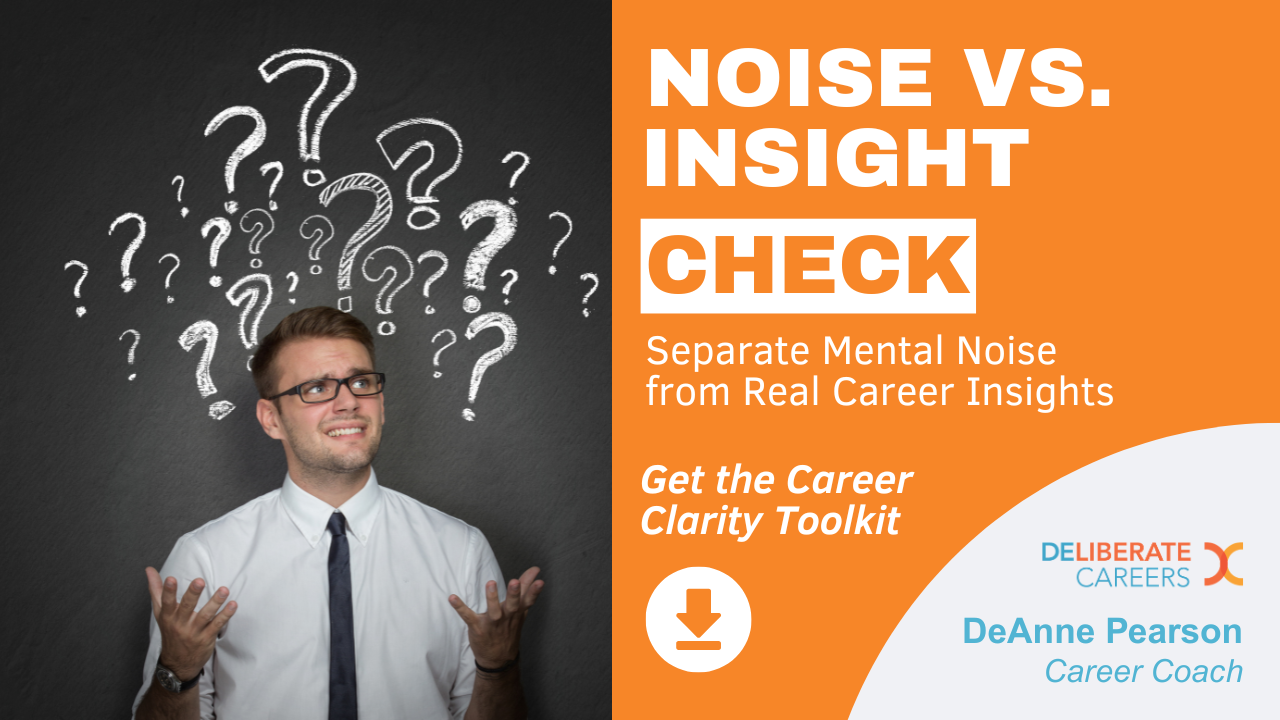
Tool #1: Noise vs. Insight Check
When you feel stuck, it’s easy to assume all your thoughts are equally important. Spoiler: they aren’t. Some are just noise (fear, self-criticism, or burnout) while others are actual insights pointing you toward what’s next.
Here’s the thing about noise: it’s real. Your feelings of overwhelm, exhaustion, or self-doubt are valid. Recognizing insights can bring you clarity and relief moving forward. Paying attention to real insights helps you turn awareness into action without dismissing the burnout or frustration you’re feeling.
How to Tell Noise From Insight
Think of noise as reactive thinking—thoughts that are emotionally charged, repetitive, or self-critical, like fear or guilt. Insight, on the other hand, is information your brain is giving you about your work life, often tied to patterns, recurring feelings, or moments of energy and engagement.
Some quick ways to recognize the difference:
- Noise often uses words like should, always, or never, and makes you feel stuck or paralyzed.
- Insight often points to something specific: a task, a moment, or a part of your role that consistently sparks energy or frustration.
- Noise keeps you spinning in circles; insight nudges you toward a clear next step.
This worksheet helps you capture your thoughts and start separating mental clutter from meaningful career insights.
How Noise and Insight Show Up
“I should stay. Leaving would be irresponsible.” That’s your fear talking, keeping you stuck.
“I haven’t felt challenged in two years.” That’s a real insight. Maybe it’s time to explore a stretch role, take on bigger projects, or even consider a new company.
“Maybe I’m lazy.” That’s burnout talking, not a reflection of your ability.
“I feel energized when mentoring junior staff.” That’s an insight showing a pull toward leadership and people development. This could be the spark that leads you into coaching or team-focused roles.
“I’ve invested too much to change now.” That’s sunk-cost thinking holding you back.
“The parts of my job I love aren’t in my role description.” That’s a clue your role might need a redesign — or that a pivot is calling your name.
👉 Download the Noise vs. Insight Check to start noticing what your thoughts are really telling you and what action they might actually be nudging you toward.

Tool #2: Values in Action Map
Sometimes the reason you feel stuck isn’t about skills, experience, or opportunity. It’s about values misalignment—the parts of your work that don’t reflect what matters most to you.
This worksheet helps you identify your core work values and see how present they are in your day-to-day role. It’s a quick way to see if your job is fueling or draining you.
How to Read This Tool
Strongly present (+2) – You feel this value clearly and consistently in your work.
Somewhat present (+1) – You notice it occasionally, but not reliably.
Neutral / Not present (0) – This value is mostly missing from your work.
Frequently missing (-1) – You regularly feel this value is absent.
Actively opposed (-2) – Your role often forces you to act against this value.
The goal isn’t to judge your current job. It’s to see patterns and understand what’s really driving your satisfaction or frustration.
How Values Misalignment Show Up in Real Life
You value Autonomy–having the freedom to make decisions and take ownership of your work. But in your current role, every choice needs approval, and endless meetings eat up your energy. That misalignment may mean you’d thrive in a position where you can make decisions independently.
You value Growth–constantly learning and stretching your skills. But your projects have been the same for three years with no new challenges. That gap signals your growth value isn’t being met, suggesting a company with advancement opportunities or a new industry could be more energizing.
You value Impact–seeing your work make a meaningful difference. But your contributions feel disconnected from real outcomes, leaving you frustrated. This misalignment may point to mission-driven roles or strategic positions that better align with your desire to make a difference.
You value Collaboration–working closely with others to create better results. But your role is mostly isolated, so you rarely get to interact with teammates. This signals your collaboration value isn’t being fulfilled, and might mean you need a position with more teamwork.
You value Recognition–feeling that your efforts are noticed and appreciated. But your hard work consistently goes unnoticed, leaving you frustrated. This gap might indicate you need a culture that actively celebrates contributions.
Each insight you uncover helps you decide what matters most and what changes could make your work more energizing and fulfilling.
👉 Download the Values in Action Map to see which of your values are thriving, and which might be quietly holding you back.

Tool #3: Decision Readiness Scorecard
Knowing what’s wrong and knowing what you want isn’t always enough. Often, the real blocker is readiness—how prepared you are mentally, emotionally, and practically to take the next step in your career.
This worksheet helps you assess key areas that make career moves possible. By seeing where you’re strong and where you’re blocked, you can focus on the areas that need attention before acting. The goal isn’t to judge yourself. It’s to identify where extra guidance could make the difference and help you move forward confidently.
What Readiness Looks Like
Clarity of Goals - I know what I want next.
You might feel uncertain about your next step even after months of thinking. That lack of clarity makes every decision feel exhausting and keeps you stuck in indecision.
Confidence - I believe I can make a move successfully.
You may have skills and experience but doubt yourself when considering a promotion, new role, or pivot. Low confidence stalls action even when opportunity is present.
Resources - I have the knowledge, skills, and network to act.
Perhaps you’re clear on your goal but unsure how to get there—you don’t know the right people, skills, or steps to take. This gap can make progress feel impossible without guidance.
Energy & Motivation - I feel energized to take action.
Burnout or fatigue might make even small steps feel overwhelming. Low energy signals it’s time to recharge before tackling the next career move.
Decision-Making - I can choose without overthinking.
If you overanalyze options endlessly, even clear goals can’t translate into action. Recognizing this helps you focus on building frameworks for faster, confident decisions.
Support - I have people or structures to support me.
Feeling isolated or unsure who to lean on makes moving forward harder. Low support indicates you may need mentors, accountability partners, or coaching to navigate the change.
Alignment - My next step matches my values & priorities.
Even if you’re ready in every other way, a move that clashes with your priorities can drain energy and motivation. Low alignment is a signal to clarify what matters most before acting.
Assessing these areas gives a clear picture of where you’re ready and where extra guidance could make the difference.
👉 Download the Career Action Readiness Scorecard to see how ready you truly are for your next career move, and book a Clarity Session with me to turn these insights into a concrete plan.
Why Coaching Makes These Tools Work
Worksheets create awareness. Coaching creates momentum.
These tools will help you start thinking differently about your career. Applying them to your unique situation is where most people get stuck, and that’s where coaching makes a huge difference.
- outside perspective
- structured decision-making
- accountability
- strategic positioning
- confidence in your next move
I’ve been in your shoes. I’ve felt that frustration, spinning and second-guessing, and I’ve guided dozens of clients through the same fog. A few focused conversations can accelerate clarity more than months of thinking alone ever could.
Start With the Career Clarity Toolkit
Download the Career Clarity Toolkit today to:
- Organize your thoughts
- Understand your dissatisfaction
- Identify what might need to change
- See how ready you are to act
And if you want someone in your corner while you make sense of it all, a Discovery Call with me can turn reflection into a deliberate, actionable strategy, so your next move isn’t just guesswork.
Author